Mortgage lenders have always required precise, data-driven coordination between pricing and secondary market execution. As market conditions shift more rapidly, and as investor expectations evolve, aligning origination and capital markets strategy has never been more important. Yet many organizations still manage pricing logic, guideline rules, post-lock workflows, hedging assumptions, and investor execution paths in separate systems.
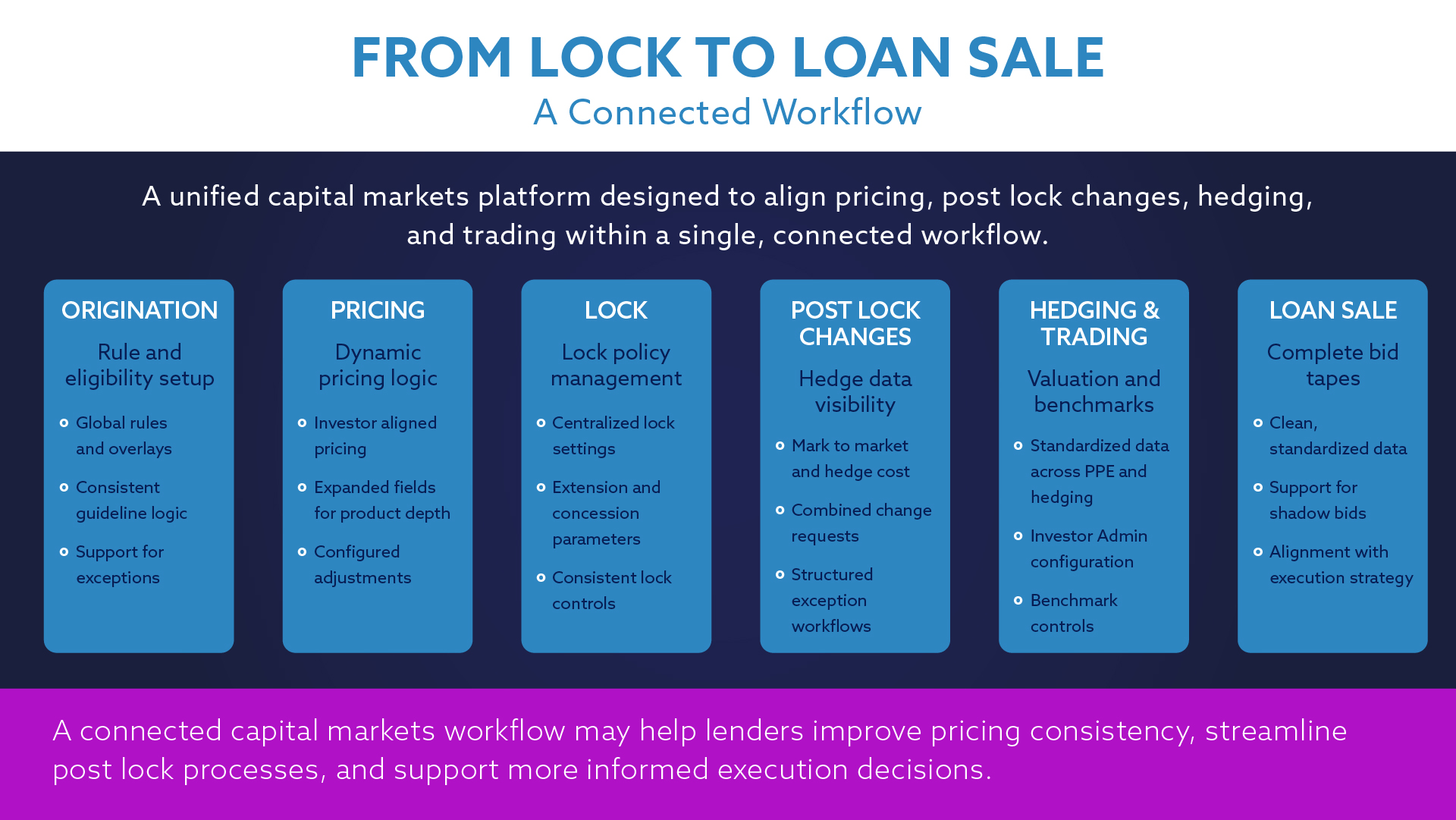
Platform-wide configuration within a connected capital markets platform may help unify these functions. By centralizing rules, workflows, and valuation assumptions across Optimal Blue’s Product, Pricing and Eligibility (PPE) engine and CompassEdge hedging and loan trading platform, lenders can create a more cohesive strategy from lock request through loan sale.
This article explores the role of unified configuration in strengthening pricing accuracy, post-lock consistency, risk modeling, and overall capital markets efficiency.
The importance of a shared configuration layer
Pricing begins with data, rules, and eligibility logic. Execution depends on investor preferences, hedge positions, mark-to-market values, and delivery assumptions. Without a shared structure linking the two, small inconsistencies can create operational friction and potential margin impacts.
A connected configuration framework helps lenders standardize:
Pricing overlays
Eligibility rules
Adjustments and fees
Investor filters and delivery settings
Post-lock policies
Hedge benchmarks and valuation parameters
Managing these elements in a single system may help reduce duplicate work, support more consistent pricing, and allow teams to respond more quickly to market changes.
Streamlining pricing updates with centralized rule management
Mortgage pricing requires constant adjustment. Market shifts, investor updates, temporary overlays, and new product considerations all require rapid configuration changes. Rules Optimizer within the Optimal Blue PPE gives lenders a centralized way to manage these rules. By writing rules at a global level and applying them across investors, lenders can reduce operational complexity and improve consistency.
Effective dates and expiration settings may also help teams create temporary or situational rules while maintaining full transparency and control. This enables faster response times without requiring users to manually adjust investor-level configurations.
Making exception management more predictable and transparent
Exception lending is increasingly common. Borrowers may require alternative qualification paths, additional documentation, or pricing adjustments that fall outside standard guidelines. Without a structured exception workflow, teams may depend on manual approvals that are difficult to scale or audit.
Configurable exception guidelines allow lenders to define:
Products eligible for exceptions
Boundaries for guideline flexibility
Documentation requirements
Pricing implications
Approval workflows and restrictions
These guidelines give loan officers clarity at the point of pricing and help secondary and capital markets teams evaluate exceptions with consistent, documented criteria. This approach may help improve transparency while preserving flexibility in competitive market conditions.
Embedding hedge and execution data into post-lock workflows
Post-lock decisions affect both the customer experience and secondary market outcomes. Extensions, concessions, profile changes, and product changes all influence profitability, and evaluating those impacts can be complex.
Integrating hedge data directly into post-lock workflows helps address this challenge. When mark-to-market values, hedge cost, pull-through expectations, and likely execution pricing are visible within the same workflow used to approve post-lock changes, decision makers gain a more complete view of potential impact. This connectivity helps align pricing and secondary strategies at the loan level, improving consistency and reducing manual research.
Combined change request workflows add further efficiency by allowing originators to submit multiple post-lock changes within a single workflow, which may help reduce cycle time and improve internal alignment.
Preparing for emerging products and expanded data needs
Non-QM growth, expanded property types, alternative income structures, and evolving borrower profiles continue to shape the mortgage landscape. Accurate pricing and risk evaluation rely on having complete and standardized data fields available at the point of pricing and in downstream analyses.
Expanded standard fields help lenders support evolving product needs without relying on custom fields or workarounds. When these fields are supported natively in the PPE and automatically carried through to the hedging and trading system, lenders gain consistency across their pricing, valuation, and investor delivery workflows.
This support helps lenders prepare for future market expansion in non-QM and other specialized loan types.
Giving secondary teams more control with investor and benchmark configuration
Investor configuration is central to pipeline valuation and execution strategy. When lenders can configure loan filters, delivery assumptions, mark-to-market parameters, and investor activation directly within their capital markets platform, they gain more rapid, flexible control over their execution strategy.
The ability to add new investors, configure mark-to-trade settings, and enable shadow bids within a standardized framework supports more dynamic investor evaluation. When lenders can test and evaluate investors quickly, they may uncover new pricing advantages or expand execution options.
Benchmark configuration also benefits from being centralized. Understanding how a different benchmark coupon impacts pipeline risk is easier when the hedging analytics and configuration settings live within a single interface. This visibility supports more informed hedge management decisions.
Connecting origination, pricing, and execution through technology
Lenders increasingly prioritize efficiency, accuracy, and speed in capital markets operations. A platform-wide configuration framework helps unify pricing logic, post-lock workflows, eligibility rules, valuation assumptions, and execution strategy across systems that traditionally operated separately.
When these processes are managed through a connected platform with a shared configuration structure, lenders may benefit from:
Greater pricing consistency
More accurate and timely secondary market insights
Reduced operational complexity
Improved exception management
Stronger alignment between origination and execution
For organizations seeking to modernize capital markets operations, unifying configuration is a powerful step.
To learn more about how Optimal Blue supports connected pricing, hedging, and trading workflows, visit OptimalBlue.com.
Commentary included in this piece shall not be construed as, nor is Optimal Blue providing, any legal, trading, hedging, or financial advice.